Bigfoot Population Numbers
How many Bigfoot are there?
The late great Dr. Grover Krantz once hypothesized that 2,000 Bigfoot may exist in the Pacific Northwest alone. The late great Dr. Jeff Meldrum offered a lower estimate saying there are 200 black bear for every 1 Bigfoot. With a black bear population in the U.S. at about 400,000 (not counting Alaska) that equals 2,000 lower 48 Bigfoot.
The 2,000-population total for Bigfoot seems high to me. I would estimate a population with a low end of 500, and a high end of 1,000, with individuals being highly mobile (as seen with the white New York Bigfoot) and the same individual accounting for multiple sightings across multiple areas, tricking us into thinking Bigfoot is more numerous than it actually is.
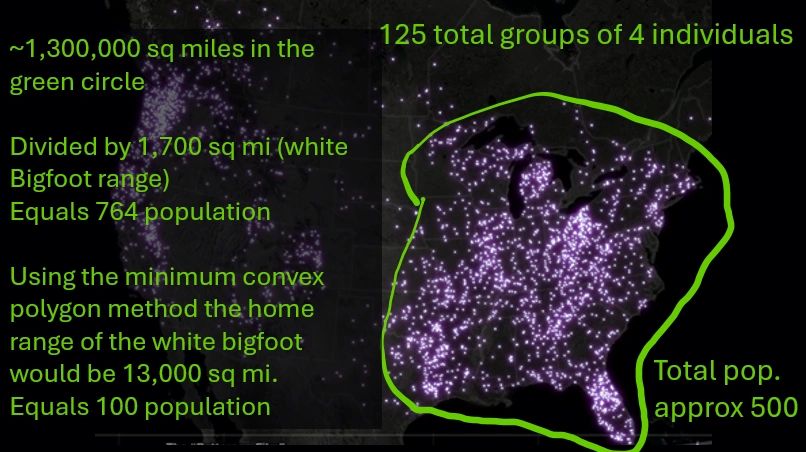
The white New York Bigfoot had a minimum point-to-point range of 1,700 square miles, which is massive (male black bear have an approximate home range of 100 square miles). Using the minimum convex polygon method it's home range would be 13,000 square miles, which is about the size of the state of Maryland. For reference, the minimum convex polygon method is used to estimate the home range of an animal by constructing the smallest possible convex polygon around a set of location data points.
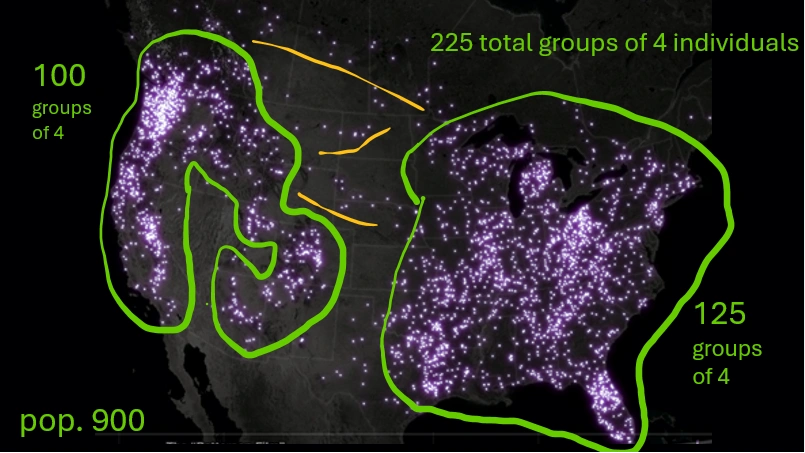
We can extrapolate the data from the white New York Bigfoot to a broader scale. In the first image below, the area circled in green contains approximately 1,300,000 square miles. If we divide that by the white Bigfoot's minimum range of 1,700 sq mi, we get a population of 764 individuals. Using the minimum convex polygon method, we get a population of 100 individuals. I think it is fair to use a middle ground of 500 individuals. Bigfoot are often sighted in groups, so using a standard number of 4 individuals per group would give us 125 groups of 4 individuals in the Eastern United States. The second image below includes the Western United States. The map shows an obvious population distribution southward at the Mogollon Rim in Arizona, north to the Rocky Mountains, west to the Pacific Northwest, and back south into California. Interestingly and predictably avoiding desert areas and the great plains, or areas with a lack of extensive forest cover. The orange lines show sightings that likely represent connective corridors from the eastern population to the western population. Because the western population is smaller in geographic size I estimated a slightly lower population of 100 groups of 4 individuals. Even with the lower total this still represents a higher population density than in the east due to the deeper, denser forests of the pacific northwest. Altogether this yields a total lower 48 (with a smidge of Canada near the Washington State border) population of about 900 individuals. I wouldn't be surprised if the total dips down to around 500 individuals, as we cannot forget that the total land area circled contains places that cannot harbor a Bigfoot, such as bodies of water and urban sprawl.
It is easy to think that the population of Bigfoot should be higher than only 900 individuals. That is a tiny number in a huge landscape. But a small number makes sense in terms of the reported elusiveness of the creature, as tens of thousands of Bigfoot would likely yield far more sightings and videos. You have to ask yourself, how elusive can this creature possibly be? It doesn't have an invisibility super power. With a high population count it would be impossible to evade detection no matter how secretive. Along these lines of thought, if a single individual is sighted multiple times across a large geographic area, this also fits with a more realistic view of their evasive abilities as it would show they can be spotted, that they aren't disappearing magicians, and they make mistakes, like any other creature in the woods.
A high population count would also leave a noticeable ecological impact. Thousands upon thousands of huge omnivorous creatures would be far more environmentally apparent than what they currently are, unless those huge creatures were very few in number.
This website uses cookies.
We use cookies to analyze website traffic and optimize your website experience. By accepting our use of cookies, your data will be aggregated with all other user data.